Library Mirabilis · The Journal
The Black Dogs of England: Folklore's Favorite Omen
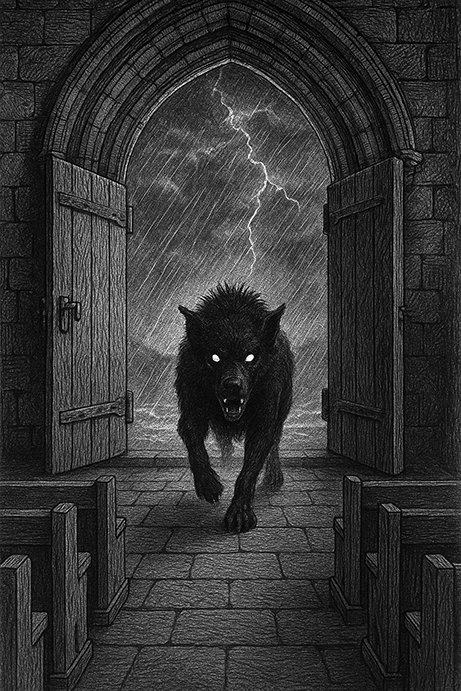
Black dog folklore has been told in England for at least five centuries, and nearly every county has its own hound. East Anglia has Black Shuck. Yorkshire has the Barghest, the West Riding has Padfoot, Somerset has the Gurt Dog, and on the Isle of Man the Moddey Dhoo haunts Peel Castle. Most are huge, many have fiery eyes, and nearly all are met on a lonely road at night. Unusually for a phantom, the black dog also has a dated first appearance in print.
Bungay, 1577: the dog makes the news
On August 4, 1577, a violent storm broke over Bungay, Suffolk, during morning service at St Mary's. Abraham Fleming, a London translator and editor, wrote it up the same year as A Straunge and Terrible Wunder. In his account a black dog ran down the church in a flash of fire, passed between two people kneeling at prayer, and "wrung the necks of them both at one instant clean backward." A man it brushed past was left shrunk "as it were a piece of leather scorched in a hot fire." The same morning the church at Blythburgh, a few miles off, was struck too: a man and a boy were killed, and the scorch marks on its north door are still pointed out as the devil's fingerprints. Fleming probably worked from oral reports, and the weather alone could account for the deaths. What stands out is that East Anglians in 1577 already pictured sudden death out of a dark sky as a black dog. Bungay put the dog on its coat of arms.
The taxonomy of the phantom hound
The regional dogs sort roughly by temperament. Some are death omens. The Barghest is said to roam York's snickelways, and seeing it means doom; anyone who sees the Moddey Dhoo is expected to die soon after. Some are dangerous in themselves: Padfoot gains power over anyone who speaks to it or strikes it. The church grim began as a burial custom. The first person laid in a new churchyard had to guard it against the Devil, so a black dog was buried in the north part of the ground to take the duty instead. A good few, this being England, are protective. Mothers on the Quantock Hills let their children play out alone because the Gurt Dog would watch them, and it was said to walk lone travelers home.
The places are the constant, and readers of our corpse roads piece will recognize them: lanes, bridges, crossroads, churchyards, gallows sites and old ways. Black dogs keep to boundaries.
From the lanes to the library
Writers took the dog early. Sir Walter Scott put the Moddey Dhoo into The Lay of the Last Minstrel. The best-known borrowing is Arthur Conan Doyle's The Hound of the Baskervilles (1902), which drew on the Dartmoor story of the squire Richard Cabell, said to have sold his soul to the Devil, whose tomb was haunted by black hounds after his death in 1677. The phrase "the black dog" for low spirits turns up in letters between Hester Thrale and Samuel Johnson in the 1770s, and Winston Churchill, writing to his wife in 1911, hoped a doctor could help if "my black dog returns."
Why the dog endures
Most local phantoms faded with the people who told of them. The black dog did not, and reports of it kept coming in after cars had headlights. A big dark dog at the edge of a lane at night is frightening without any help from folklore, and the stories gave that fear a shape and a set of rules. They also offered a warning, which a sudden death usually doesn't give.
The full pack, Shuck, the Barghest and their cousins across the world's dark roads, is collected in Cryptids & Contested Creatures, the Library Mirabilis illustrated compendium of beasts that refuse to vanish, alongside the rest of the Victorian menagerie, all of it illustrated in the Victorian manner.
If something black pads beside you on a dark lane, the folklore's advice is the same everywhere: do not speak to it, and do not touch it.
Hear of new volumes first
Leave your address and we will write when a new book or a new story arrives.