Library Mirabilis · The Journal
Joanna Southcott's Box: A Prophecy Still Waiting for Its Bishops
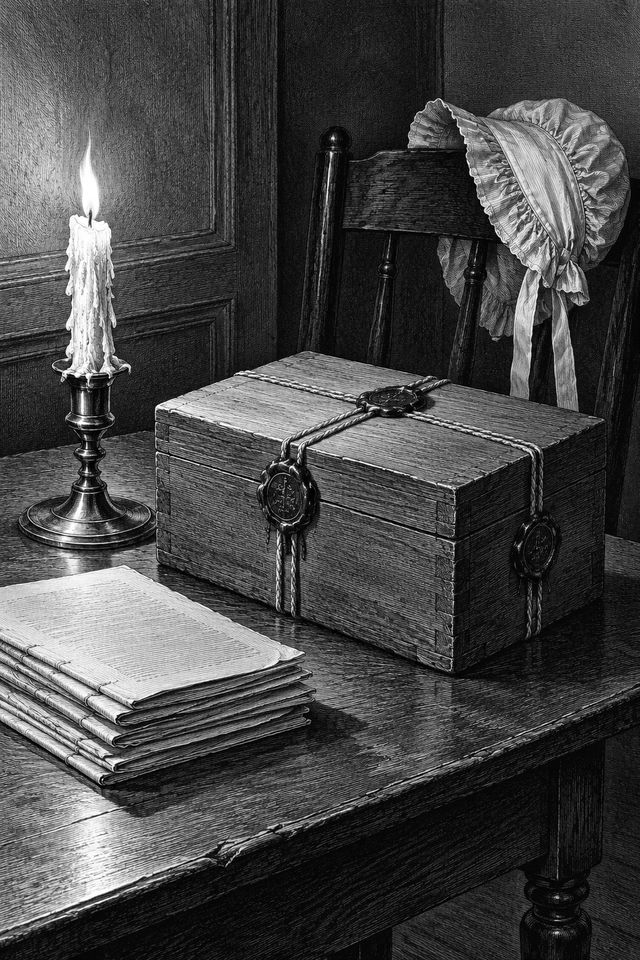
Somewhere in England, in a secure location chosen by a charitable trust, sits Joanna Southcott's box. It is supposed to hold prophecies that will save the nation. It is not to be opened except in a time of national crisis, and then only with twenty-four Church of England bishops in the room. The bishops have never come. The box has been waiting for them since 1814, and the story of how a Devon servant came to leave it behind takes in an estimated hundred thousand followers, a pregnancy that was not one, and a society in Bedford that bought a hall to open the box in and paid for billboards asking the bishops to turn up.
A servant hears a voice
Southcott was born in 1750 in Taleford, a hamlet in Devon, and spent most of her life in domestic service in the west of England. For four decades there was nothing remarkable about her. Then, in 1792, she became convinced that God was speaking to her, and she started recording the words, roughly versified to begin with. When she put the experience into print in 1801, she gave the voice's charge to her in plain words: "Thou shalt prophesy in my name; and I will bear thee witness."
The 1801 pamphlet, The Strange Effects of Faith, opened a run of more than sixty titles across thirteen years, and the following that gathered around her was estimated at a hundred thousand people.
Prophecy checked against the news
Her writing covered a lot of ground: commentary on scripture, political forecasts, private revelation. She foretold harvests and wars, the fall of Napoleon and the coming millennium, and argued that her visions were exact enough to prove God had sent her. The voice on the page was part King James Bible and part Devon countrywoman, which must have made it sound at once familiar and startling.
Her followers treated the prophecies as something to test. They copied them out carefully and compared them with events, and every hit counted as proof of supernatural foresight. Her critics kept the other column, the misses. Neither tally really explains her. What she offered was nearness: the sense that God was still talking, right now, through a living woman, at a time when the Church of England, with its comfortable clergy and lukewarm sermons, offered nothing like it.
Passports to heaven
Apart from the box, the seals are the most solid thing she left. Each was a printed certificate with her signature and a wax impression, and it was meant to secure its holder a place among the 144,000 elect on the day of judgment. Prices ran between twelve shillings and a guinea, and people wanted them badly. Some were sewn into clothing, others hidden in houses as charms against evil. A seal was a small, portable promise, and it made you one of a chosen company, whatever the wider world thought of the woman who had signed it. The wider world was split on that question, between prophet and lunatic. It is the kind of object that earns a movement its place in Curious Cults.
Shiloh, 1814
At sixty-four, Southcott announced that she was carrying Shiloh, the child of prophecy, the Messiah. Her body showed every outward sign of it, and several doctors examined her and agreed she was expecting. Believers traveled from all over England and bought an elaborate crib. The papers covered it with equal parts mockery and fascination.
No child came. Her health failed quickly, and she died on December 27, 1814. The doctors at the post-mortem found no evidence of pregnancy, though they did note a buildup of fluid that might account for the symptoms. Her followers kept the body for a while, expecting her to rise, and agreed to bury her only after it began to decay. Even then the faith held. Many said heaven had taken the child, or that he had been born on a spiritual plane, or was still on the way. The movement's central promise had failed as plainly as a promise can, and the believers went on believing.
The box and its keepers
That is where the box comes in. Southcott left it sealed, with two conditions: a national crisis and twenty-four bishops. Its contents, she said, would rescue the country. A promise held in reserve like that can never quite be proved wrong, which may help explain why it has lasted.
Its most devoted keepers arrived a century later. In 1919 Mabel Barltrop, a clergyman's widow, founded the Panacea Society in Bedford. She took the name Octavia and believed she was the Shiloh of Southcott's prophecies. In 1929 the Society bought a house and turned it into a hall where the box could be opened when the day came. Members could write in for a blessed piece of linen, which they soaked in a jug of water and drank from four times a day. The Society said from 1957 onward that the genuine box was in its keeping, and in the 1960s and 1970s it bought newspaper space and billboards to urge the bishops to come.
There was a rival. Back in 1927 Harry Price, the psychical researcher, had produced a box he said was Southcott's and opened it in front of a single bishop, the Bishop of Grantham. One, not twenty-four. Inside he found an old horse-pistol, a nightcap, a purse, earrings, dice, a lottery ticket and a few books and papers. It reads like the contents of a forgotten drawer. The Society's answer was short: wrong box.
Ruth Klein, the Society's last member, died in 2012, and the Society's box went to a charitable trust that holds it somewhere secure. So the story stands about where Southcott left it, with a sealed container, a set of conditions and a bench of bishops that has never filled. Whatever is inside, prophecy or another nightcap, the twenty-four have yet to gather and find out.
Hear of new volumes first
Leave your address and we will write when a new book or a new story arrives.