Library Mirabilis · The Journal
The Hellfire Club: Mock Monks and Rumor Beneath West Wycombe
Say "the Hellfire Club" and most people picture hooded figures in a cavern. What the record supports is odder. There was a baronet who would later become Chancellor of the Exchequer, a ruined abbey on the Thames with a joke from Rabelais set in colored glass above a door, and a warren of passages cut into a Buckinghamshire chalk hill, where several of the most influential men in the country drank a great deal of wine and, by hostile report, dressed as monks.
A name borrowed from London
Sir Francis Dashwood did not invent the name. The first Hellfire Club was a London society, founded in 1718 by the Duke of Wharton (Philip by name), and its whole program was to ridicule religion and respectable morals. A royal decree shut it down in 1721. The idea spread anyway, and through the rest of the eighteenth century clubs on the same pattern turned up around Britain and Ireland, generally wherever young men with money and an education had decided that polite society was a bore.
So the public's name for Dashwood's circle already came with a story attached. The members preferred a grander and sillier title, styling themselves Friars of St. Francis of Wycombe, a saint's name that happened to match their founder's.
The baronet and his motto
Dashwood was a baronet and a member of Parliament who rose in time to the Exchequer, where his lack of distinction surprised nobody acquainted with him. As a young man he had traveled through Europe and the Ottoman Empire. He came home a collector of classical art and a committed libertine, with a hearty scorn for religious hypocrisy. He wanted a society where good dinners and free philosophical talk could mix without the Church looking on.
He founded it in the late 1740s. The brothers met first at a rented house near London and later moved to Medmenham Abbey, a ruin on the Thames that Dashwood leased in 1751 and remodeled for them. He decorated it with classical imagery mixed with deliberate blasphemy, and over one doorway, in stained glass, he placed Fay ce que vouldras ("Do what thou wilt"), the rule of Thélème, the imaginary abbey in Rabelais's Gargantua. Rabelais had made up his abbey. Dashwood had a real one, and he borrowed the rule.
Down into the chalk
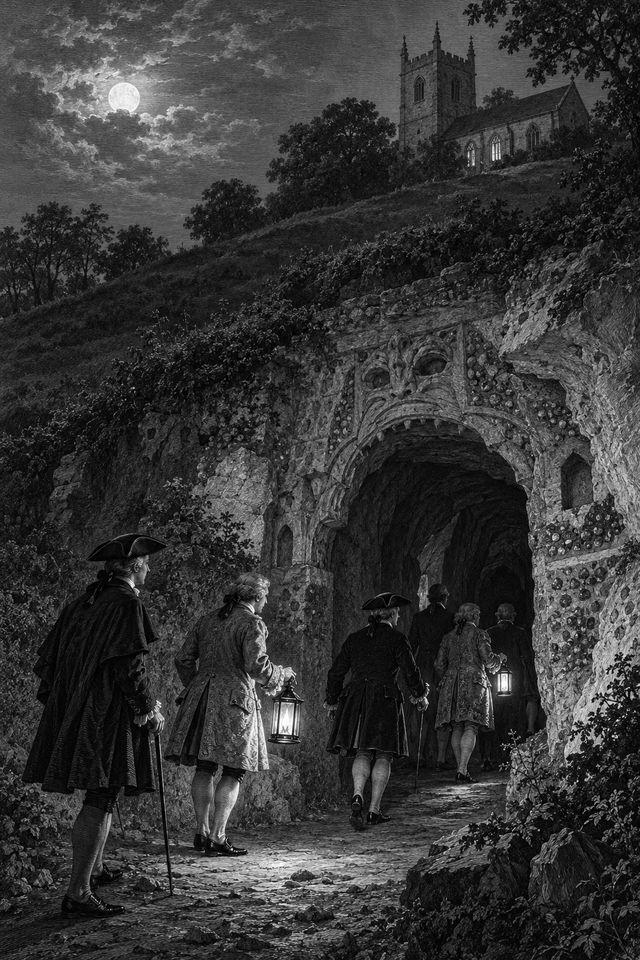
In the 1750s Dashwood also had tunnels and chambers dug into the chalk at West Wycombe, running a quarter of a mile into the hills. The stated reasons were charitable and practical. The work employed laborers who had none, and the chalk went into road-building. Both may have been true. Both were also convenient.
Try to imagine the place after dark. A quarter of a mile is a long way to walk into a hill, with the passages lit by candles and the rooms dressed in pagan and satirical decoration, so that a guest arriving with a glass in hand met old gods and mocking jokes in the flicker. The wine came in enormous quantities. Above lay the ordinary Buckinghamshire night, and below it a private underworld built by a man who loved to provoke. An underground room suggests secrecy even when nothing much is hidden, and it is a short step from "they meet under the hill" to "they worship the devil down there."
Why the rumors outran the evidence
Here the record thins. Almost every account of the rites comes from people who hated the club. They described mock services with the members dressed as monks, the worship of pagan idols, and women referred to as nuns. Whether any of it was truly transgressive, or mostly an elaborate piece of theater designed to shock, can no longer be settled. Dashwood's friends were plainly not pious. That is a long way from proof that they practiced the satanic rites their opponents described. Of all the groups in Secret Societies, this one may have the widest gap between its reputation and its paperwork.
The guest list fed the rumors. John Montagu, the Fourth Earl of Sandwich, came regularly, as did the politician John Wilkes and the poet Paul Whitehead, along with other men of rank. The painter William Hogarth, whose picture of Dashwood shows him as a friar, sometimes appears on the list too. Benjamin Franklin, a close friend who helped Dashwood revise the Book of Common Prayer, is reported to have visited Medmenham while he was in England. A prayer book collaborator dropping in on a blasphemous fraternity: the story is full of contradictions like that.
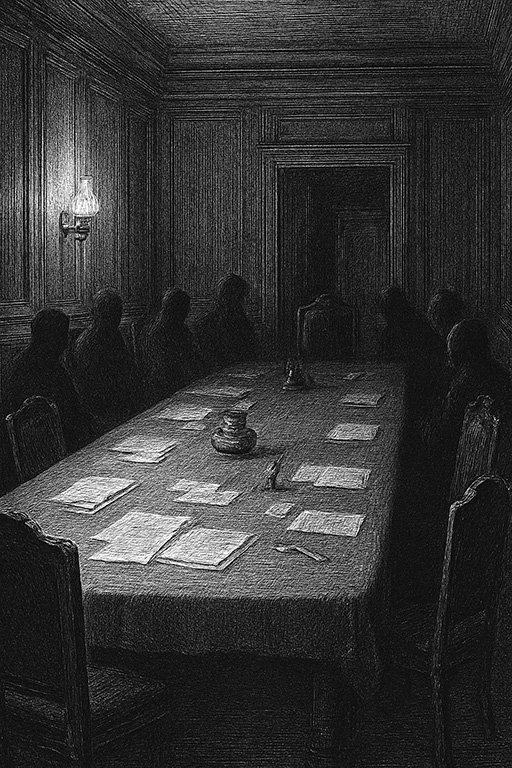
What the members certainly did was less lurid and probably mattered more. They ate, drank and argued, and they used their weight. In the late 1750s and early 1760s, when the club was most active, its men held real power in the Church, the Admiralty and Parliament. Medmenham and the caves served as political salons as much as party venues. Alliances were struck there and patronage handed out, and the business of government sometimes could not be told apart from the business of having a good time. A closed circle of powerful men meeting in a cave invited suspicion, and the devil was the most vivid thing to suspect them of.
Undone by a poem
The end came from inside. By 1763 Wilkes and Sandwich were locked in a nasty political feud. Wilkes and Thomas Potter had written An Essay on Woman, an obscene parody of Pope's Essay on Man dedicated to the courtesan Fanny Murray, and Wilkes had it privately printed. Sandwich, a brother of the Medmenham order himself, read it out in the House of Lords. The Lords pronounced it obscene and blasphemous, the scandal swallowed both men, and Wilkes fled to Paris.
The affair is often said to have finished the club, though the caves stayed where they were and Dashwood kept on entertaining, more modestly, until he died in 1781. There is an irony in that ending. A society that outsiders believed was hiding unspeakable rites was brought down by a dirty poem, read aloud in public by one of its own members. The tales of satanic rites outlived the friars, and so did the tunnels in the hill.
Hear of new volumes first
Leave your address and we will write when a new book or a new story arrives.