Library Mirabilis · The Journal
Real Cryptids the Victorians Believed In
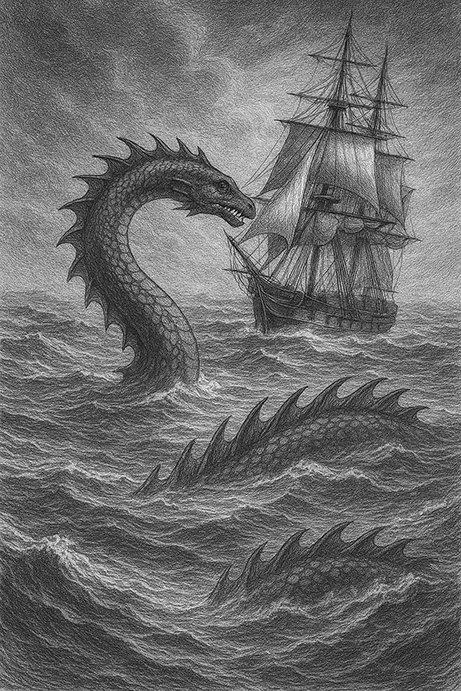
On August 6, 1848, between the Cape of Good Hope and St Helena, the officers of HMS Daedalus watched a long dark animal pass under the frigate's quarter. Captain M'Quhae said its head "was, without any doubt, that of a snake," and The Times printed the report. Victorian cryptids were news in this way, logged by naval officers and argued over in the papers. The century had decent grounds for an open mind: the map still had blank spaces, and those spaces kept producing real animals.
The age that kept being proven right
Gorillas were a travelers' tale until Thomas Savage and Jeffries Wyman published the first scientific description in 1847. Sailors had talked of the kraken for centuries, and then between 1870 and 1880 giant squid kept washing up in Newfoundland; the one stranded at Thimble Tickle Bay in November 1878 had a tentacle reported at about thirty-five feet. Henry Morton Stanley heard in the Congo of an animal the locals called the atti. Sir Harry Johnston, who never saw one alive, sent home strips of striped skin and later a skull, and in 1901 the okapi was formally named, a forest relative of the giraffe.
Each of those animals had been dismissed before it was cataloged. Cryptozoology still runs on that argument, and in the nineteenth century the argument kept winning.
The sea serpent: the respectable monster
New England had a sea serpent before Britain did. In August 1817 fishermen and the crew of the schooner Caravan reported one off Cape Ann, Massachusetts, and the Linnaean Society of New England appointed a committee, whose report cautiously describes "a large marine animal, supposed to be a serpent." Sightings around Gloucester went on into 1819.
The witnesses made the sea serpent respectable. Naval officers and whole crews gave matching accounts, and these were men who had spent years at sea looking at whales and seals. Once the squid strandings showed the ocean could hide very large unclassified animals, a big unknown serpent looked like a fair guess. (In 2015 the biologist Gary Galbreath argued that the Daedalus animal was a sei whale.)
Beasts of the land and the dark
On land the record was thinner. In 1832 B. H. Hodgson wrote that his guides in northern Nepal had seen a tall, upright, long-haired creature; he decided it was an orangutan. In 1899 Laurence Waddell recorded Himalayan footprints and put them down to a bear. "Abominable Snowman" did not reach English readers until 1921. At home Britain had its black dogs, Shuck and his regional cousins, padding beside people on dark lanes. The phantom big cats of the moors came later, with the tabloids.
The strangest case was a Londoner. Spring-heeled Jack was first reported in 1837. On the night of February 19, 1838, a man came to Jane Alsop's door in Old Ford claiming to be a policeman who had "caught Spring-heeled Jack here in the lane." When she brought him a light, she said, he threw off his cloak and vomited blue and white flame. Reports went on for decades, and the last is said to have come from Liverpool in 1904. Nobody was ever convicted.
Why the Victorians believed
Exploration turned up a real wonder every few years, so a new animal was easy to credit. Natural history was a popular hobby, and a reader with a cabinet of shells felt able to weigh a report. The older folklore of black dogs and water horses was still told by people's grandparents, and it could be written up in the language of the new science. Many a Victorian cryptid was an old country story with a naval officer's signature added at the bottom.
Today's lake monsters and moor cats come with the same mix of testimony and local legend, and their case files usually open in the nineteenth century.
The full cabinet
These creatures and dozens more are gathered in Cryptids & Contested Creatures, the Library Mirabilis illustrated compendium of mysterious beasts. It covers more than forty cryptids in six chapters, from animals laughed at until someone produced a specimen to things that sit between flesh and folklore. It draws on historical accounts, expedition journals and eyewitness testimony, illustrated in the Victorian manner.
It suits skeptics who want the evidence and believers who like a good sighting, and anyone who suspects the map still has a blank space or two.
Hear of new volumes first
Leave your address and we will write when a new book or a new story arrives.