Library Mirabilis · The Journal
Corpse Roads and Crossroads: Folklore of In-Between Places
Corpse road folklore starts with a burial problem. In medieval Britain the right to bury often belonged to an old mother church, and outlying hamlets had to carry their dead to it, sometimes over miles of moor and fell. At Blockley in Gloucestershire the hamlets of Stretton-on-Fosse and Aston Magna had corpse roads of about four miles and two miles. The routes went by many names (bier road, burial road, coffin line, lych way, lyke way), and they crossed some of the loneliest country in the kingdom. A great deal of folklore grew up around them, covering how the dead should be carried, what walked the route afterward, and whether a path the dead had used still belonged partly to them.
The rules of the road
The customs were precise. The corpse's feet were kept pointing away from the family home for the whole journey, so the spirit would not find its way back. Coffin stones were set along the way, and in some accounts these, along with wayside crosses and lychgates, were placed and blessed so the coffin could rest without tainting the ground or letting the spirit out. One still stands on the old route from Rydal to Ambleside in the Lake District, where the bearers set the coffin down to rest. In their ideal form the roads ran straight, because spirits were said to fly on a direct course close to the ground, and the way was kept clear for them. Where a route met running water it went over a bridge or stepping stones, since spirits were held unable to cross water on their own.
Breaking the customs had specific consequences. One of the oldest beliefs held that any land a corpse was carried over became a public right of way, and a field crossed by a funeral was expected to give poor crops afterward. Phantom funerals, processions seen at night where none was walking, are reported on corpse roads more than anywhere else. On Dartmoor's Lych Way, which runs to Lydford, people have described monks in white and ghostly funeral parties on the path.
The crossroads: the anti-churchyard
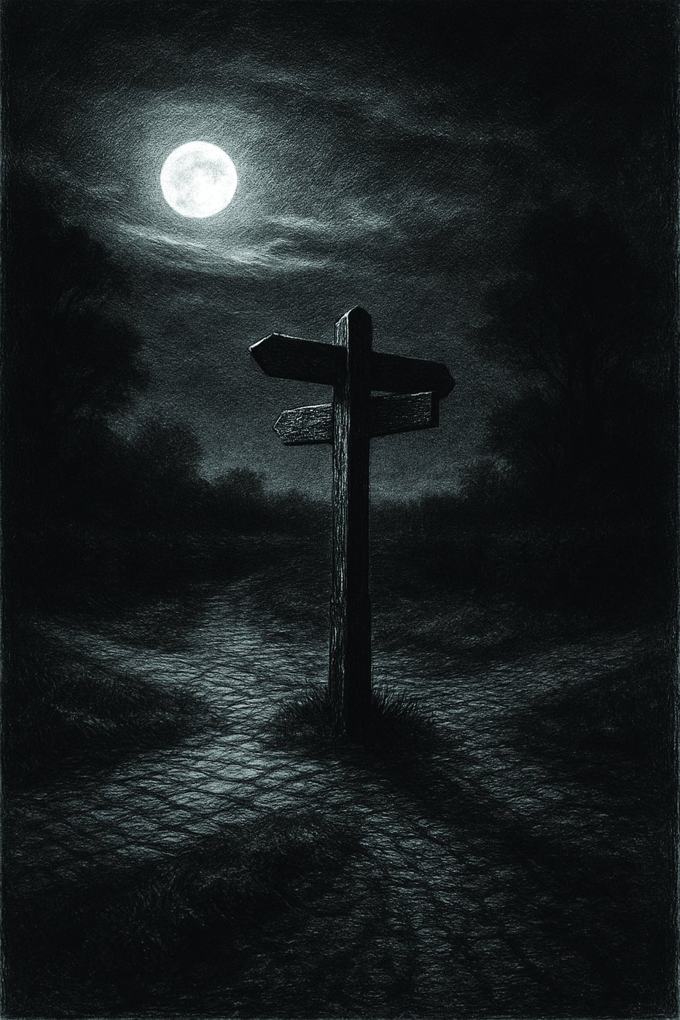
The corpse road was for the respectable dead. The crossroads took the rest. Suicides and executed criminals were buried at crossroads in England, sometimes with a stake driven through the body to hold them down, until the Burial of Suicides Act of 1823 banned both highway burial and the stake. One explanation given was that a spirit rising where four ways meet could not tell which road led home. The crossroads also belonged to no parish and no household, which made it a place outside the community's own ground, and in tale after tale across Europe it is where the devil can be met at midnight.
The night ways
A whole nocturnal geography grew up around these routes. On St Mark's Eve people kept watch for the wraiths of those due to die that year; at Fryup in Yorkshire an old woman was remembered for keeping "Mark's e'en watch" beside a track called the Old Hell Road. Lychgates, where the bier waited for the priest, collected hauntings of their own. Black dogs, the great omens of the English lanes, are often reported along corpse roads and old ways. In effect the countryside held a second road network for the dead, running alongside the living one and crossing it at the places the stories warn about.
Why the old ways still prickle
Many corpse roads survive as public footpaths, and walkers on them often say the same thing: a path with that history feels different, especially at dusk and on your own. The anthropologist Arnold van Gennep gave a name, in 1909, to the middle stage of any rite of passage, the liminal stage, from the Latin for threshold. Van Gennep wrote about rites. A funeral carry fits his scheme closely, though, since the dead person had left home and had not yet reached the churchyard, and the bearers had a rule for every step in between.
The full map
Corpse roads and crossroads are one chapter of Liminal Spaces: Thresholds, Crossings, and Places In Between, the Library Mirabilis book on the architecture, folklore and psychology of in-between places. It also covers attics, stairwells, abandoned platforms and overgrown gardens, with illustrations in the Victorian manner. The companion piece on why thresholds frighten us opens the wider territory.
If you walk a corpse road, the old rule was to keep to the path.
Hear of new volumes first
Leave your address and we will write when a new book or a new story arrives.