Library Mirabilis · The Journal
The Icelandic Yule Cat, Grýla and the Thirteen Yule Lads
Most Christmas monsters want to know whether you have been good. The Icelandic Yule Cat wants to know whether you have anything new to wear, and if you don't, it may eat you. Over a few centuries Iceland gathered a whole household of seasonal horrors around it: an ogress called Grýla who cooks children, her shabby, idle husband, and thirteen troll sons who descend on the farms one at a time before Christmas Eve. Taken together they make one family, and not a happy one.
Grýla, the matriarch
Manuscripts of Snorri Sturluson's Prose Edda, from the 1220s, name Grýla as one of the troll-wives, though a later scribe may have slipped the entry in, and they give her nothing beyond the name. The first sketch of her reportedly comes from a verse in the Sturlunga saga: a troll-woman with fifteen tails. Her name is usually read as "growler."
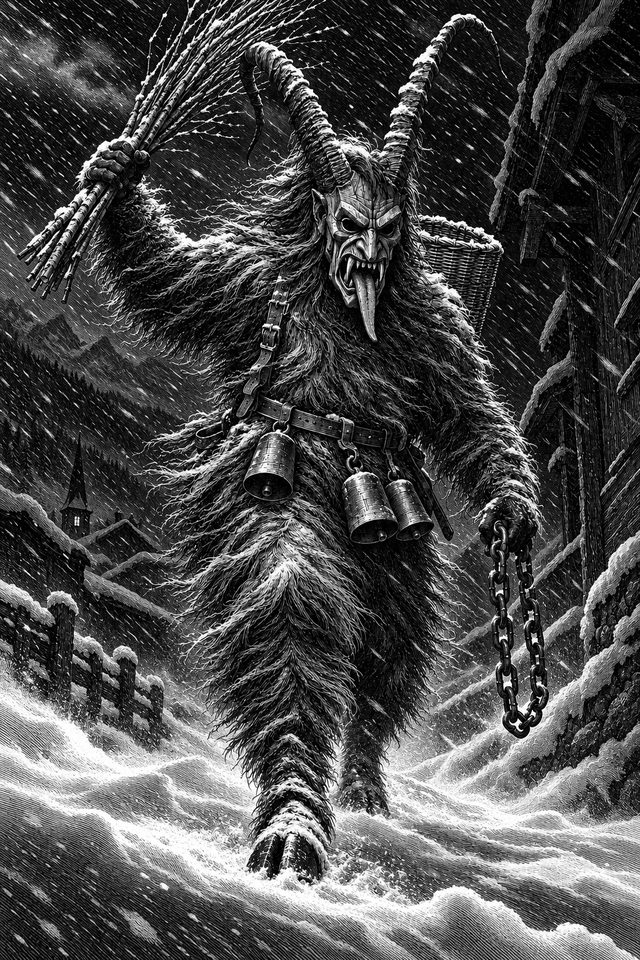
Before she had a season, oral tradition made her a general ogress of mountains and darkness who ate disobedient children, and each generation seems to have added a feature: goat horns, hooves, ears hanging to her shoulders, teeth like lumps of charcoal, a second set of eyes at the back of her skull, and, in some tellings, three hundred heads with three eyes apiece.
The Grýlukvæði of around 1638 to 1644, the oldest poem to put her at Christmas, has her begging from farm to farm after dark for naughty children to cook. It was probably written by a parson, Guðmundur Erlendsson of Fell in Sléttuhlíð, together with the farmer and poet Ásgrímur Magnússon, his brother-in-law. Each Christmas she comes down from her cave with a big sack, collects the disobedient, and takes them home to her cauldron. The stew is said to be her favorite dish.
A household that mirrors the farm
Her husband, Leppalúði, "the raggedy one," is a lazy man in rags who mostly waits for dinner. He first appears in a poem by Hallgrímur Pétursson from about 1648 to 1649, explaining that Grýla is laid up in bed after her trip to Sléttuhlíð. In some tellings Leppalúði is husband number three; the first two, Gustur and Boli, are not said to have survived the marriage.
The sons began as dangerous trolls, each tied to some domestic offense, and later tradition brought in the Cat as the family pet. Assemble the clan and you get a list of what an isolated farm could least afford: idleness, pilfering, and neglect of the people in your care.
Thirteen sons, one per night
The Yule Lads, the Jólasveinar, keep a strict timetable. Icelandic children put a shoe on the bedroom windowsill on the evening of December 11, and on each of the next thirteen mornings it holds a small present or a rotten potato. One brother arrives each night from December 12, and each stays thirteen days, so the whole set is in the country only on Christmas Eve, and the last leaves at Epiphany.
The brothers are specialists. Stekkjarstaur, Sheep-Cote Clod, comes first and bothers the sheep, hobbled by his wooden peg-legs. The ones after him lurk in gullies for milk, scrape the crust off pans, lick spoons and bowls, slam doors, gobble skyr, swipe sausages from the rafters, peep through windows and sniff out the patterned laufabrauð, or leaf bread, and Ketkrókur lowers a hook for the smoked lamb. Last is Kertasníkir, who trails children carrying tallow candles. A candle was a rare Christmas treat, and he wanted one too. Read in order, the raids move from the sheep pens into the heart of the house.
Some stories had only nine sons. Thirteen first turns up in a poem from the late 1700s, and folklorists have collected around sixty different Lad names. Jón Árnason printed their names for the first time in 1862, in his great folktale collection Íslenzkar þjóðsögur og æfintýri. In 1746 the Danish crown issued an ordinance on household discipline that banned frightening children with Yule Lads or ghosts. Nobody knows how far the rule reached on remote farms.
The cat at the window
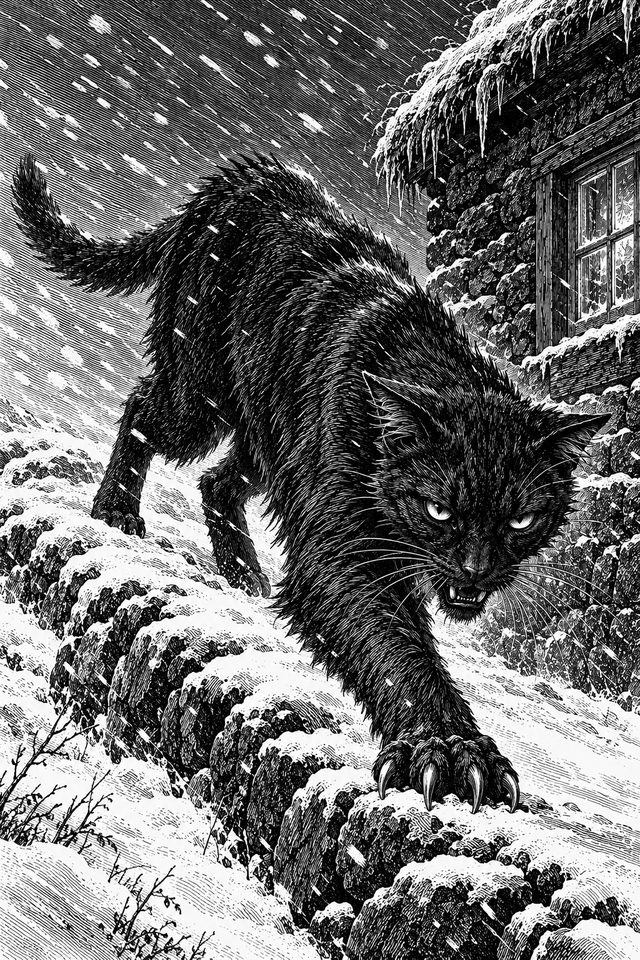
The Yule Cat came later. Its first sure appearance is in Jón Árnason's collection, which gives no source for it. There it is a huge, savage animal that roams at Christmas after anyone who has not been given a single new piece of clothing. In one version it looks in at the farmhouse window to check the children's presents: a new garment and it moves on, none and it eats the child's supper and then the child. A milder version takes only the "Christmas bit," the extra food each member of the household got at Yule, and leaves its victim to go hungry into the winter.
One explanation for the clothes rule goes back to the autumn wool work, when every farm washed, carded, spun and knitted its fleeces before winter. On this reading a new garment proved the work was done, and a farmhand who finished it got one. A well-behaved child might still go without because the household had fallen behind, or because the farmer kept the proceeds for himself. Seen that way, the Cat is aimed at the adult who never handed over the shirt.
The poet Jóhannes úr Kötlum made it famous with "Jólakötturinn," in his 1932 collection Jólin koma, the same book that fixed the canonical thirteen Lads. His poem never tied the Cat to Grýla. Later storytellers did, and by mid-century it had become the ogress's pet.
How the family softened
The Lads were child-snatching trolls in the seventeenth century, the subject of a gore contest among eighteenth-century storytellers, and clumsy thieves by the nineteenth. In the early twentieth century they started turning up at public Christmas parties with sweets, and in the 1930s they sang on the radio, led sing-alongs and made school visits. Now they are Iceland's Santa Claus times thirteen.
The Cat has kept more of its bite. Plenty of Icelanders still make sure everyone in the house has at least one new thing to wear by Christmas Eve, and children still hear, more or less seriously, that the Cat is watching. The language even has an idiom for ending up with nothing new: að fara í jólaköttinn, to go into the Christmas Cat.
Hear of new volumes first
Leave your address and we will write when a new book or a new story arrives.