Library Mirabilis · The Journal
The Krampus Legend: Saint Nicholas and His Christmas Devil
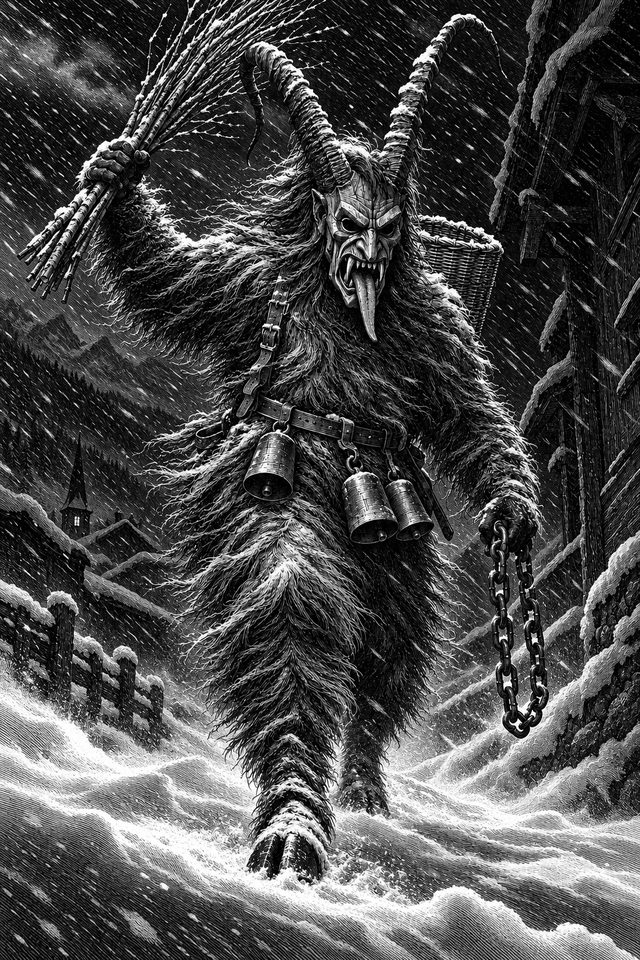
You hear him before you see him. The Krampus legend reaches the Alps on the evening of December 5 as a scrape of iron links over stone and a clank of cowbells the size of buckets, and whatever is making that noise is also growling. This is Krampusnacht in Austria. Some parents hurry the children indoors; the traditional ones steer them toward the front door. Either way, he is not the one with the presents.
The saint's dark assistant
Saint Nicholas has a reputation to protect. On the eve of his feast he made the rounds of Alpine homes with fruit, nuts and small gifts for the children who had earned them. Punishment was beneath him, or at least a bad look for a saint, so the job went to a companion with no reputation to lose.
That companion is a hairy, horned giant, black or dark brown, with at least one cloven hoof and a pointed tongue hanging out past his fangs. Many people read his chains as the Church keeping the Devil bound. He carries a fistful of birch rods, the ruten, for ordinary bad behavior, and a tub or basket on his back, the butte, for the hopeless cases, who are hauled off somewhere the stories never bother to name.
He is usually said to enter the written record in the sixteenth century, in mountain country now divided among Austria, southern Germany and the borderlands of Slovenia, Hungary and Croatia. The name probably comes from the Bavarian Krampen, a claw, but Matthäus Rest, a social anthropologist, warns that nobody can be certain of it.
Masks, schnapps and a staff past the window
For most of the tradition's life, Krampus was a neighbor in disguise. Young men of the village, often fortified with schnapps, put on suits of sheep or goat hide and carved wooden faces and called at houses where the children had been lined up for inspection. They chased, grabbed, and handed out a few light strokes of the birch, and the grown-ups paid them off with more schnapps. Next morning, December 6, a child either found presents in a shoe or understood that the visitor had taken notes and would be back.
The masks in Salzburg's Gastein Valley, Rest notes, are heavy and ugly on purpose, with six to ten horns set in pairs. Arthur Moinat, a self-taught carver at Thumersbach on the Zeller See who took up the craft in 2010, models each face first and then lets the timber argue back: he follows the grain and works around the knotholes.
Families staged their own versions. Jules Linner, a teacher in Austria, described hers on The Big Ponder, a Goethe-Institut podcast. Her father carried Saint Nicholas's staff past the window where the children were sure to see it, and down in the cellar her grandfather shook chains. Every child in that house knew Krampus took the bad ones away.
A long campaign against the Devil
You will often read that the Catholic Church condemned Krampus as far back as the twelfth century. Nobody has found a source from that period to back it up. Church authorities are said to have found a horned, hoofed figure a little too close to the real Devil for comfort.
The serious attack came between 1934 and 1938, from the Christian Social Party and Austria's fascist government. According to reports, the party newspaper called for a boycott, and some towns, Lienz in East Tyrol among them, banned the Krampus dances. A school administrator complained in 1953, "There is too much fear in the world already," and nominated Krampus as the place to start, and in the 1950s the government circulated pamphlets branding him an evil man.
The villages that had kept Krampusnacht for centuries ignored all of it. Some accounts even say the 1930s and 1940s brought a revival in mask carving, and those faces of wood, horsehair and ram's horn are what most people now picture when they hear the name.
Greetings by post
In Austria and Bavaria, from the late nineteenth century into the early twentieth, Krampus also traveled by mail. The Krampuskarten were color greeting cards in which the demon chases shrieking children through the snow, crams them into his basket, dangles them over flames, or thrashes them with real gusto. People posted them to relatives as casually as a card of robins. Christina Albert, raised in Texas by German and Austrian parents, got cards from Krampus commenting on her conduct. Years later she recognized the handwriting as her grandmother's in Vienna. Krampus had been Omi all along.
Krampusnacht now
The Krampuslauf, a street parade of costumed Krampuses, may have borrowed its model from the older Perchtenlaufen, which is first recorded in the late sixteenth century. The runs have grown bigger and rougher. Mountain towns earn much of their annual income over Christmas, Rest points out, and the runs let locals blow off steam before the visitors arrive. In 2013 a series of runs in East Tyrol sent eight people, most with broken bones, to the district hospital in Lienz, and over 60 more went home after treatment. The Krampus association in Anif, in Salzburg state, has put its rules in writing: a light brush with birch or a cow's tail is allowed and a real blow is not, nobody drinks until the mask is off, and frightened children have a Krampus-free zone to retreat to.
NPR reporters Rob Schmitz, Ryan Benk and Ed McNulty followed the Salzburg run in December 2025. A few hundred club members from Austria and Bavaria suited up at a stadium, and more than 200 rode city buses into the old town. There they lunged, swatted, tarred faces and rang their bells, while Saint Nicholas in white and gold walked ahead with candy and an untroubled smile. Each Krampus wore a number on his back, so anyone struck too hard could report him. A four-and-a-half-year-old boy perched on his father's shoulders, face pressed into his dad's neck and mittens over his eyes. He was in good company. Nicklaus Bliemslieder, nineteen, first put on the costume at five, and he said: "I was never scared of being a Krampus, but I was scared of the Krampus."
Hear of new volumes first
Leave your address and we will write when a new book or a new story arrives.