Library Mirabilis · The Journal
Why the Victorians Told Ghost Stories at Christmas
Ask most people to name a Christmas story and they will name one with a ghost in it. Marley arrives wrapped in a chain of cash-boxes and ledgers, three more spirits follow, and a miser is frightened into kindness by visitors from the grave. Few readers notice how odd it is to keep the brightest festival of the year with stories about the dead.
The Victorians did not find it odd. In 1891 Jerome K. Jerome opened his comic collection Told After Supper by pointing out that the reader would already know the date, because "It always is Christmas Eve, in a ghost story." The joke only works if everyone is in on the custom, and by then everyone was.
An older darkness under the feast
The custom is older than Dickens by a long way. Around 1611 Shakespeare gave the boy prince Mamillius a line in The Winter's Tale that could stand over the whole tradition. Asked by his mother for a story, he answers: "A sad tale's best for winter. I have one / Of sprites and goblins." Hermione tells him to sit down and do his best. The audience at the Globe would have known the scene from home: a dark evening, a fire, and a frightening story told to a small circle.
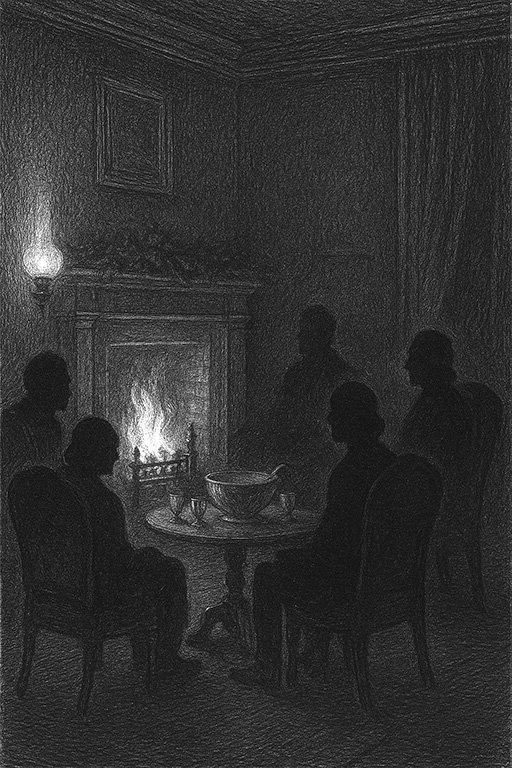
Christmas gave those evenings a fixed date. The household was together, work had stopped for a few days, and the nights were the longest of the year. A ghost story drew people closer to the fire, and when it was over the fire was still there.
Dickens lit the fire, but he did not start it
A Christmas Carol came out on 19 December 1843, and its first printing of 6,000 copies had sold out by Christmas Eve. It put the ghost at the center of the English Christmas, but Dickens's larger contribution came later, as an editor.
He ran the weekly Household Words from 1850 and All the Year Round from 1859, and each December he put out an extra Christmas number. Many of these numbers were haunted. Elizabeth Gaskell's "The Old Nurse's Story" first appeared in the Household Words Christmas number for 1852, A Round of Stories by the Christmas Fire. In December 1859 the first Christmas number of All the Year Round was The Haunted House, with a ghost assigned to each room: Wilkie Collins took the cupboard room, Adelaide Anne Procter the picture room, Hesba Stretton the clock room, and Gaskell the garden room. Readers came to expect a chill with their December magazine, and writers learned to supply it.
By the time Jerome wrote Told After Supper he could state the rule flatly: "Whenever five or six English-speaking people meet round a fire on Christmas Eve, they start telling each other ghost stories."
The scholar who read them aloud
James's stories were heard before they were printed. M. R. James, a medieval scholar at King's College, Cambridge, and later its Provost, wrote ghost stories to read to friends and students as a Christmas Eve entertainment. His first reading took place in October, not December: on 28 October 1893 he read "Canon Alberic's Scrap-Book" to the Chit-Chat Club in Cambridge. The Christmas readings followed. In the preface to Ghost Stories of an Antiquary (1904), James notes that most of the stories in the book "were read to friends at Christmas-time at King's College, Cambridge."
He dedicated the book to "all those who at various times have listened to them." His listeners were already indoors, with the cold at the window, and a story only had to suggest that the cold could get in.
The tradition never really died
The custom has turned up in odder places since. In 1963 Andy Williams recorded "It's the Most Wonderful Time of the Year," written by Eddie Pola and George Wyle, and among the parties, the mistletoe and the caroling it lists "scary ghost stories." Eight years later, on 24 December 1971, BBC One broadcast The Stalls of Barchester, the first film in its A Ghost Story for Christmas strand. The strand ran until 1978, came back in 2005 with James's "A View from a Hill," and since 2018 has put out a new film nearly every year.
How to revive it this winter
You need very little. Find a fire or its nearest equivalent, one good story, and one person willing to read it aloud while everyone else stays quiet. Choose something Victorian or Edwardian that builds slowly and never shows too much. James's "Number 13" or Gaskell's "The Old Nurse's Story" would both do. Let the last line land and let the silence sit for a moment before somebody laughs and gets up to refill the glasses.
Hear of new volumes first
Leave your address and we will write when a new book or a new story arrives.