Library Mirabilis · The Journal
M.R. James: A Beginner's Guide to the Ghost Story Master
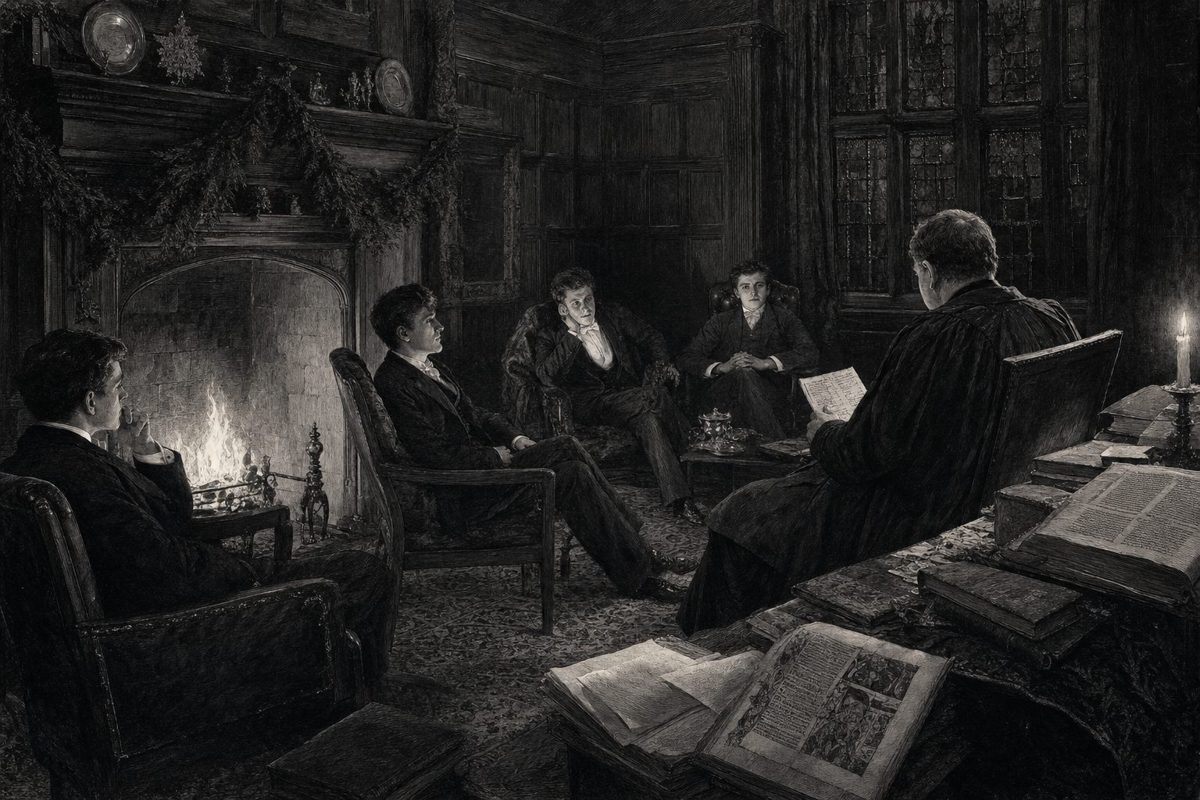
On October 28, 1893, Montague Rhodes James read two ghost stories aloud at a meeting of the Chit-Chat Society, a Cambridge discussion club. They were "The Scrap-book of Canon Alberic" and "Lost Hearts." He was thirty-one, a fellow of King's College, and already spending his days cataloguing medieval manuscripts. English ghost stories have been measured against his ever since. If you have never read him, start here.
Who he was
M.R. James (1862 to 1936) was born at Goodnestone in Kent and spent nearly all his working life in two institutions. He was Provost of King's College, Cambridge, from 1905 to 1918, and Provost of Eton from 1918 until his death. His scholarship came out as catalogues: the manuscripts of the Fitzwilliam Museum in 1895, Peterhouse in 1899, Corpus Christi in 1912, and the Pepys Library in 1923.
The ghost stories began as Christmas Eve entertainments. He wrote a new one most years and read it to friends and students in his rooms at King's, with every candle put out but one. The first collection, Ghost Stories of an Antiquary, came out in 1904. The settings are the places he knew: cathedral towns, college libraries, the archives of country houses, and the Suffolk coast, which turns up in two of the five stories below.
What makes him frightening
James set down his rules in a few short essays and prefaces, and they explain a lot. He wanted the ghost to be "malevolent or odious." He wanted the setting ordinary enough to put the reader "into the position of saying to himself" that this could happen to him.
His victims are usually scholars or antiquaries, a little pleased with themselves, who open an old book or buy a curio and then find that something has taken an interest in them.
The creatures are known mostly by touch and texture. There is a hand where no hand should be, a thing with too much hair, and in one story "a horrible, an intensely horrible, face of crumpled linen." "Reticence conduces to effect, blatancy ruins it," he wrote, and he kept to it. There is no romance in these stories and almost no blood, and the explanation, when there is one, is usually partial.
The five to read first
Roughly from the gentlest to the most frightening:
- "Casting the Runes." Edward Dunning, a scholar, helps turn down a paper by an occultist named Karswell, and soon finds he has been marked by a curse that comes with a deadline. Jacques Tourneur filmed it in 1957 as Night of the Demon, and T. E. D. Klein put it first on his own list of the most terrifying horror stories.
- "Oh, Whistle, and I'll Come to You, My Lad." Parkins, a Cambridge professor, goes to the east-coast resort of Burnstow for a golfing holiday and finds an old bronze whistle in the ruins of a Templar preceptory. One side is inscribed Quis est iste qui venit, "Who is this who is coming?" He blows it.
- "The Mezzotint." Mr. Williams, who buys pictures for a university museum, is sent an engraving of a country house that changes slightly each time someone looks at it. Paul Theroux called it "the most frightening story I know."
- "Count Magnus." Mr. Wraxall, a traveler gathering material for a book in Sweden, grows too interested in a long-dead nobleman with a terrible reputation, and James says just enough about what follows him.
- "A Warning to the Curious." Paxton, an amateur, goes looking for a buried Anglo-Saxon crown on the Suffolk coast at Seaburgh, James's version of Aldeburgh, and finds out that it has been guarded.
Each of the five has an ordinary man, an old object and a curiosity that goes too far.
Where to read them
Some of his stories are on the Journal's Story Shelf. Christmas Ghost Stories includes "Number 13," his story of a hotel in the Danish town of Viborg and a room number that is not supposed to be there, alongside tales by Gaskell, Edwards, Benson and others, each one illustrated and introduced.
Start with "Casting the Runes."
Hear of new volumes first
Leave your address and we will write when a new book or a new story arrives.