Library Mirabilis · The Journal
The Mari Lwyd: The Horse Skull That Sings at Your Door
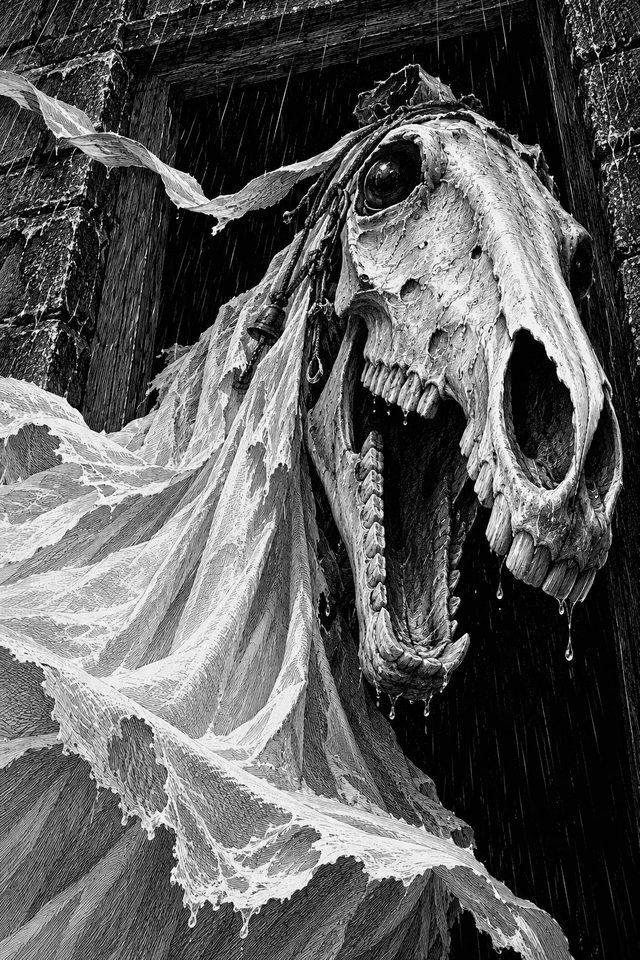
Picture a knock on a black night in the valleys of south Wales, somewhere between Christmas and Twelfth Night. You lift the curtain rather than the latch, and a horse's skull looks back at you. It wears ribbons like a show pony, its eye sockets hold glass that catches the lamplight, and when it moves the jaw claps shut with a dry crack. Behind it stands a crowd of singers who would very much like to come in. This is the Mari Lwyd, and for a long stretch of Welsh history the only polite way to keep her out was to beat her in an argument conducted in rhyme.
Building a mare from bone
There is a grim thrift to the way she was made. The skull was a real one, scrubbed clean and fixed to a wooden pole, with a spring rigged so the lower jaw could snap. Nobody made a fresh Mari each winter, either. The same head spent most of the year buried in lime until someone dug it up again in December.
Then came the dressing up: colored ribbons, rosettes, sometimes tinsel or sequins, and glass eyes (green, more often than not) in the sockets. Under a white sheet that reached the ground, a hidden bearer held the pole and worked the jaw. She had handlers. A Groom or Ostler walked ahead with a whip, making a great show of keeping her in check, and Punch and Judy might tag along with a Sergeant and a Merryman for the music. Indoors she earned her reputation, charging about the room, neighing and snapping at the children while the Groom pretended to hold her back. On a dark street the illusion must have been unnerving: a dead animal walking with intent, festooned like a bride.
The battle on the doorstep
What set the Mari Lwyd apart from an ordinary band of mummers was the pwnco, the sung contest at the threshold. Her party sang a request to be let in. The people inside, door firmly shut, sang back their reasons for refusing: the house was a mess, the fire was out, there was nothing in the cellar. Then came fresh verses, and fresh replies, both sides inventing on the spot and trading jibes and ever more creative excuses. A bout could run an hour or longer and finished only when somebody ran dry. If the household gave out first, the door opened and the company came in for food and ale. If the visitors gave out, they tramped on to the next house.
In practice the Mari seldom lost. Having her in the house was believed to bring luck for the coming year, so most families let themselves be beaten. Still, consider the terms. To keep a horse's skull off your hearth, you had to out-talk it in verse, through a shut door, in the cold.
The song collector Peter Kennedy caught one bout on tape at Llangynwyd, near Maesteg, on Christmas Eve 1956. Outside a farmhouse, William David Thomas led the Mari's side; inside, the farmer, David Jenkins, led the answers, spinning them out as long as he could before he let the company in.
A late paper trail and a contested name
The written record starts later than you might expect. The traveler J. Evans saw the custom while touring Wales in 1798, and his book, A Tour Through Part of North Wales, printed in 1800, describes a New Year's Day visitor bundled up in blankets and gear, wearing "a factitious head like a horse," whose companions knocked at doors until let in, after which he ran about the room alarming everyone. By the middle of the nineteenth century the custom was thoroughly documented, with dozens of examples, most of them in Glamorgan, Monmouthshire and Carmarthenshire. The busiest documented period runs from 1850 to 1920. How far back it goes before Evans, nobody knows.
Nor can anyone settle what the name means. Iorwerth Peate, the Welsh folklorist who studied the custom in the 1930s and 1940s and still found it alive in Cardiff, Bridgend, Llangynwyd, Neath and elsewhere in Glamorgan, read "Mari" as the Virgin Mary, and thought the connection might have grown stronger after the Reformation. E.C. Cawte, in his 1978 book Ritual Animal Disguise, preferred the plainer "Gray Mare," since llwyd is Welsh for gray. The question remains open. Peate, founder of the Welsh Folk Museum at St Fagans, thought the Mari older than Christianity, an idea most later folklorists have dropped. It is tempting to see an Otherworld beast from Celtic myth in that hollow-eyed skull, but no document links them. Her documented relatives are humbler: she belongs to the British family of Christmas animal disguises, alongside the Hooden Horse of Kent, and sits among the stranger seasonal visitors in Christmas Cryptids.
Sermons and a second life
The Mari kept walking into the twentieth century. Writing in the journal Man in 1935, Peate described a Mari taken round the Mumbles, outside Swansea, the previous Christmas Eve, with a dozen singers and one stop at a chemist's shop. Around the same time some Swansea boys, lacking a skull, used a pillow. But the custom was fading. Fewer people spoke Welsh, the spread of Methodism brought frowns at the drinking and noise, and in some places the local clergy set themselves against it. The Baptist minister William Roberts had already condemned it, in The Religion of the Dark Ages (1852), as "a mixture of old Pagan and Popish ceremonies" fit only for antiquarians. He also wrote down twenty verses of the song, which is how a hostile text became one of the custom's better records.
By the 1960s only a few communities still kept her, Llangynwyd chief among them, where the gap is said to have lasted no more than a year or two. Through the 1960s and 1970s St Fagans taped and filmed the last performers, and that archive later fed the revival. The folk club in Llantrisant built a Mari of its own, and the town counts its revival from 1980. She now turns up all over Wales, including Hen Galan celebrations at Aberystwyth, Cowbridge and Cwm Gwaun, and people have taken her to the United States and Australia.
Hear of new volumes first
Leave your address and we will write when a new book or a new story arrives.