Library Mirabilis · The Journal
The Voynich Manuscript: The Book Nobody Can Read
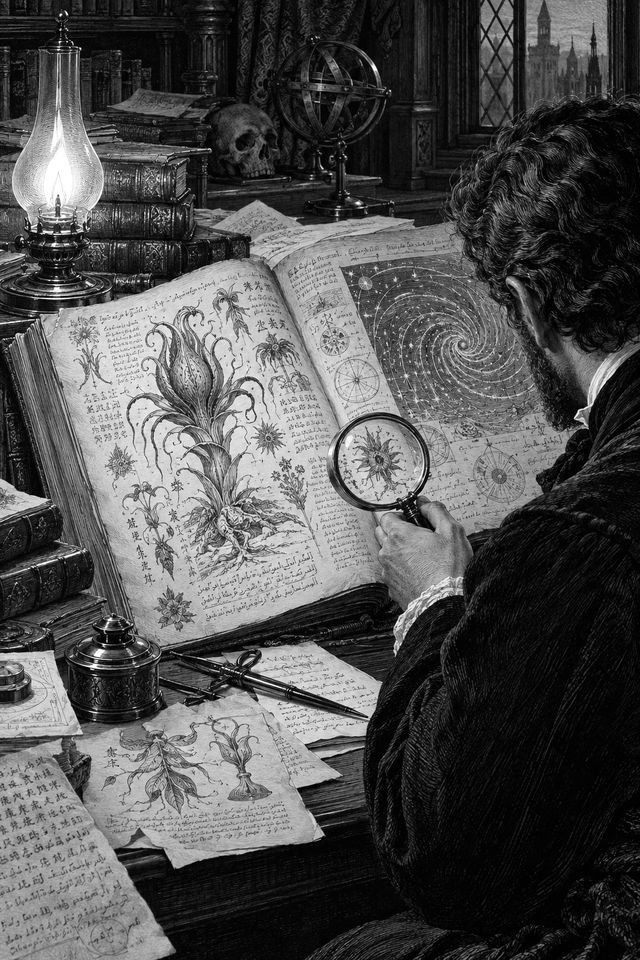
Since 2020 anyone with a laptop can page through the Voynich Manuscript, because Yale put every page of it online. The handwriting is neat and confident, the plants are drawn with real care, and there is an obvious sense that the whole thing is meant to be read. Nobody can read it. The original sits behind glass at the Beinecke Rare Book Library under the shelfmark MS 408, and for more than three and a half centuries it has defeated an alchemist, a Jesuit, a philosopher, government codebreakers and at least one researcher who was sure he had cracked it in a fortnight.
What is on the vellum
The book runs to two hundred and forty pages, bound in a vellum cover added later and polished smooth by centuries of hands. In 2009 the University of Arizona radiocarbon-dated the vellum to somewhere between 1404 and 1438, early in the fifteenth century.
The script has been given the name Voynichese, which is a label and nothing more. The letters are graceful, regular, and unlike anything in any known alphabet. Words come back again and again, much more than they would in natural speech, which hints at a small vocabulary. Yet there are enough distinct words that a simple letter-swap cipher turns the text into nonsense. Whoever held the pen was trained and fluent. They left no name and no colophon.
The pictures appear to be in conversation with the text. About half the book is botanical: roots, stems, leaves and flowers drawn the way a careful naturalist would draw them, though a good many of the plants correspond to nothing a botanist can name. Some might be real species drawn in a convention we have lost; others look assembled from parts. Then come astrological diagrams with elaborate constellation symbols, and pages that look like a druggist's recipe book. The strangest section shows small nude women, a few of them crowned, standing in pools and basins linked by pipes, with the water behaving in ways water does not. Nothing in the period's medicine explains them, and they match no known picture of pregnancy or childbirth, though they seem to sit near those subjects.
A parcel from Prague
The first readers we know of were a chain of correspondents. In 1639 Georg Baresch, a Prague amateur alchemist, wrote to the Jesuit scholar Athanasius Kircher hoping for help with the book; Baresch's own guess was that it was entirely medical. Kircher's reply, sent through a go-between, amounted to advice that the script needed hard work more than inspiration. After Baresch died the book passed to Jan Marek Marci, who in August 1665 mailed it to Kircher with a covering letter. Gossip, Marci reported, held that the emperor Rudolf II had once spent six hundred ducats on it, and that Roger Bacon, the English friar, had written it. Marci declined to take a side. His friend Johannes Kinner chased Kircher for news in 1666 and again in 1667. Then the trail goes cold for about two hundred and fifty years.
It warms up in 1912, when the antiquarian bookseller Wilfrid Voynich, born in Lithuania, came across the book at Villa Mondragone, a Jesuit college outside Rome. The Jesuits could not say where it had come from. Voynich traced it back to Jacobus Sinapius, a scholar of the seventeenth century, and possibly before him to the library of Rudolf II, the collector-emperor. When he announced the find, Voynich hoped scholars would solve it. As for the Bacon rumor, the carbon date settles it: Bacon died around 1292, more than a century before the vellum was made.
The cracks in the ink
The first confident solution was a mirage. William Newbold, who taught philosophy at the University of Pennsylvania, took up the book in 1919 at Voynich's invitation and soon came round to Voynich's view that Bacon was the author. Newbold argued that every visible letter was composed of minute strokes that only magnification revealed, and said he had read entire paragraphs confirming Bacon's authorship. In 1931 his friend John Matthews Manly dismantled the idea. The minute strokes were cracks that had formed as the ink dried on the rough vellum.
Serious codebreakers followed. William F. Friedman, the American cryptanalyst whose teams had broken Japan's diplomatic ciphers, set his study group to copying the entire text onto IBM punch cards during the 1940s. In 1950 he showed some pages to the British cryptanalyst John Tiltman, who doubted that its language had been constructed. Early in the 1950s Friedman walked an informal group of NSA colleagues through it and in the end proposed that it was an early attempt at a synthetic universal language. He never broke it. In 1976 an NSA linguist named Child suggested an unknown North Germanic dialect. Hungarian, Armenian and a mathematically built artificial language have all had their champions, and none has gathered a following. The dealer Hans P. Kraus gave it to Yale in 1969.
Four ways to be wrong
The proposals tend to sort into four groups. Perhaps it is a real language, now dead, set down by its last speaker. Perhaps it is a hoax produced later on old vellum, for fun or to catch out the credulous, the kind of thing learned forgers of the period did occasionally attempt. Perhaps it is glossolalia, trance writing with the form of language and none of the meaning. Or perhaps it is a cipher whose key has gone missing. One recent study suggested a verbose substitution cipher, with each word of some underlying language swapped for two or three Voynichese words to frustrate frequency analysis. That idea is unconfirmed, and like most theories about the book it is almost impossible to rule out.
Then there was 2019, when Gerard Cheshire, a research assistant in biology at the University of Bristol, declared the text to be "calligraphic proto-Romance" and said he had deciphered it within a fortnight. Speaking to Ars Technica, Lisa Fagin Davis called the reasoning "circular and aspirational," and Bristol later took down its reference to the claim. It earns its entry in Forbidden Books easily. Whatever it turns out to be, somebody put enormous effort into it: some 170,000 characters, each one written out by hand.
Hear of new volumes first
Leave your address and we will write when a new book or a new story arrives.